
ADVISORY BOARDS: Business and Local Community
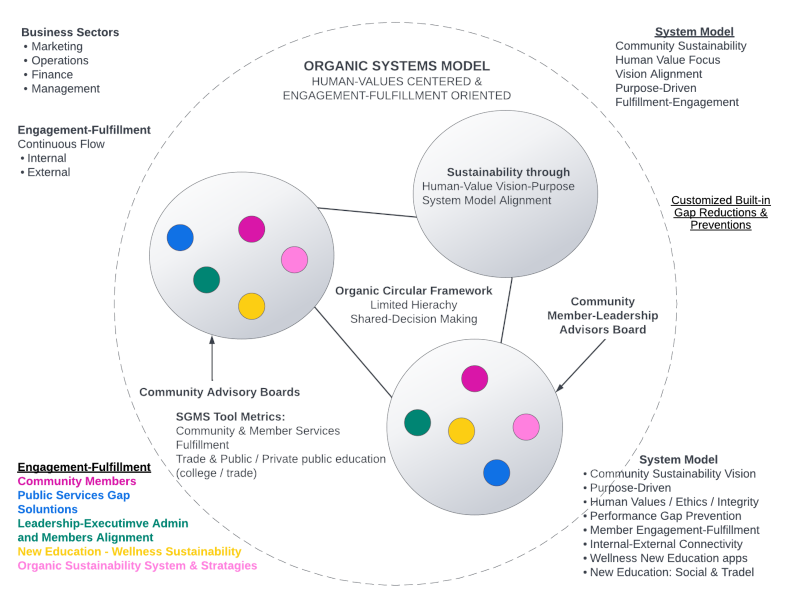
HAF Advisors provide local businesses, communities and educational institutions sustainable growth through healthy ecosystem connectivity, performance and purpose-driven engagement-fulfillment of all stakeholders.
- performance gap removals and engagement-fulfillment sustainable growth executions
- organic business model processes with engagement-fulfillment for workforce, community members and all stakeholders
Healthy ecosystem performance requires an adaptive and positive internal-external connectivity flow-engagement with all stakeholders such as
- business workforce-leadership
- common customer bases
- suppliers-distributors
- community members
- educational institutions.
External interface with state, special interest groups with controlled government funding
- governance “commercial arrangements”
- go-to-market coordination “value creation” mechanisms
- value sharing mechanisms with risk management
Think Tank Advisors
Provide clear insight and facilitate as a “think-tank”, and sounding board for either the owners, directors, or shareholders of a company (informal or formal and or both).
HAF Board Advisors “market’s best practices”
Facilitate people in the organization to test their strategic thinking and access expertise or connections that may not be readily available via other means. Incorporating collaboration and adaptability for all brands being present is available.
HAF SCHOLARSHIPS BENEFICIARIES
- Entrepreneurs
- micro-businesses
- small businesses
- educational institutions
- local communities
 Scholarships are provided free, for 3 months, to local start-ups, micro and small businesses, educational institutions, and communities.
Entrepreneurship training scholarships are approved on a case-by-case basis with internship provisions.
Educational Institutions: high school and college students are provided internships
Local communities: Scholarships provide a gap identification and solution in social connectedness, self-sufficiency, operational efficiency, security and peace rights through IT platform, education and HAF mentorship/coaching
Business scholarships include:
- an assessment of the client business model
- market performance (past to current and future planning)
- identification and solutions for sustainable growth risks and performance gaps
- organic business model with fulfillment
HAF Educational Programs Offered as Scholarships to start-up, entrepreneurs, micro-small businesses, educational institutions, local communities, high school and college students, churches and other institutions upon request.
ROLES
Ethics
HAF BOARD ADVISORS
- Avoiding conflict of interest with other advisors and organizations that individuals are associated with
- Honoring the organization’s right to choose advisors that meet their need
- Managing relationships respectfully
- Participating in transparent communication
ADVISORY BOARD ROLES & RESPONSIBILITIES
An example of an advisory board structure:


Three key roles within an advisory board structure
- a Chair
- external advisors and internal directors
- stakeholders and organizational representatives.
Scaling business uses a common structure: 1 independent Chai; , 2 external advisors and 2 internal business representatives (generally the business owner, director and/or CEO). This combination is customized to fit the business needs for balance of facilitation, external advice and follow-through for implementation.
Local community leadership may choose to customize this model for best practice.
ADVISORY BOARD CHAIRS
Appointing an independent Chair whose role is to establish and facilitate a formal advisory board structure to achieve effective advisory board outcomes. This may include:
- Establishment of new advisory board structures
- “Optimizing” advisory board assessment for effectiveness and best practice
- Assist in execution or support with advisory board planning and meetings
- Provide value-driven insights and advice
- Mentor and coaching to the business owner or executive
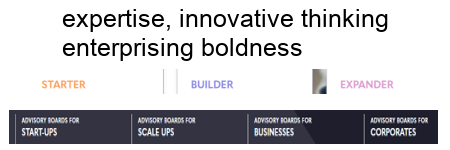
expertise, innovative thinking,
enterprising boldness.
EXTERNAL ADVISORS
External advisors are appointed for their expertise to problem solve, explore options/concepts and strategic direction. Advisory board participants will actively contribute to the goals and desired outcomes defined in the charter. This may include:
- Contribution to advisory board outcomes through value-driven insights and advice
- Agreed strategic introductions and advocacy
INTERNAL DIRECTORS & STAKEHOLDERS
Both establish (or disband) an advisory board, design and execute business decisions and plans. Internal directors and stakeholders are founders, directors, CEO’s, lead investors and other senior executives.
NEW ROLES
New roles appear such as:
- Advisory board manager
- Chair to the advisory board
- Advisor to the board

Entrepreneurship training scholarships are approved on a case-by-case basis with internship provisions.
Educational Institutions: high school and college students are provided internships.
Local communities: Scholarships provide a gap identification and solution in social connectedness, self-sufficiency, operational efficiency, security and peace rights through IT platform, education and HAF mentorship/coaching.
Interested in learning more about how you can assist or be a part of HAF? Fill out this form
Advisory Boards FAQs
[expand title=”What is an Advisory Board?”]
An advisory board of an organization provides a structured, collaborative method to engage advisors and or stakeholders.
Advisory boards members include:
- Representatives from the business or organization itself
- An independent Chair
- Selected Advisors
Members of the advisory board provide objective advice and mentoring to the business representatives. Prior to the first meeting, the Chair will define the scope of this advice based upon the results from a business needs assessment.
More detail on the roles and responsibilities can be found here_______. FAQ
Advisory Board Profile
- Independent Chair
- Charter purpose
- Advisor (s) purpose
- Structured and or informal (or both) meeting schedule, agenda and communications
- Member engagement parameters
- Mentor and Coaching to solve problem-solving Advisory Boards Help Topics?
- plan-scale-build sustainable growth and new markets
- Identify and execute “gap” solutions
- create-planning-execution of successful strategies
- successful delivery of “key organic changes” and fulfillment
- transforming business challenges & crises into “wins”
- cultivating a united and strong multi-generational workforce
- leadership and executive mastery trainings
- strategic or technical advice (IT/Engineering)
[/expand]
[expand title=”Advisory Boards Help Topics?”]
- plan-scale-build sustainable growth and new markets
- Identify and execute “gap” solutions
- create-planning-execution of successful strategies
- successful delivery of “key organic changes” and fulfillment
- transforming business challenges & crises into “wins”
- cultivating a united and strong multi-generational workforce
- leadership and executive mastery trainings
- strategic or technical advice (IT/Engineering)
[/expand]
[expand title=”What are the business benefits?”]
- Precise root cause identification
- Market Intelligence
- CEO, Executive and workforce fulfillment
- Management and workforce performance gap reduction
- Improved market strength, share, profits
- New insights
- Proven scaling tools/systems
- Test strategic thinking
- Access expertise
- Objective analysis
- Increased confidence
- Proven solutions
- Innovative thinking
- Lead successful change
- Generational Workforce Gap reduction
- Value and purpose-driven culture
- Business sustainability methods
- Reduced Gaps in Operations, Management and Operations
- Increased Revenue, net profits and market growth
- Business Exit-Sale Strategy Formula
- Professional Development Programming
- Influencer Leadership Impact
- Team Culture execution
- Customer & Workforce Retention & Loyalty
- Operational Efficiency
- Accounting System Transparency & Accountability
[/expand]
[expand title=”Who Are Advisory Board Members?”]
Skilled professionals outside of the organization (not appointed by organization shareholders) and appointed by the organization within the organization’s industry sector (i.e. legal, financial, growth, supply & logistics, technology, marketing, sustainability, etc.)
[/expand]
[expand title=”When and How does the Advisory Board Member’s Deliver their services?”]
- Semi-regular basis – 4-6x/year
- Monthly if required
- Open scheduling for “crisis or change” execution
Note: Particularly useful for high-growth businesses, family companies, crisis or change, duplicating executive functions, and installing an organizational advisory board.
[/expand]
[expand title=”What is the difference between an Advisory Board and a Board of Directors?”]
Both types of boards are very different.
Comparison:
Advisory Board
- Deliver expert value
- Not shareholder
- Consultant-problem solving
- No fiduciary responsibility
- Governance responsibility
Board of Directors
- Can be shareholders
- Are fiduciary responsible
- Legally binding decisions
Advisory Board members offer strategic insights to inform the business owner, executives, or directors, who in turn will make decisions.
Advisory boards are known in the market by many different names including advisory panel, advisory council, steering committee, think tanks, board of advice and startup boards.
[/expand]
[expand title=”How to Get Started and Hire an HAF Board Advisor ?”]
- PREPARE TO GET WHAT YOU NEED FROM HAF BOARD ADVISOR
- STATE WHAT YOUR OUTCOME IS IN HIRING HAF BOARD ADVISOR
- STATE THE OUTCOME FULFILLMENT COMPLETION DATE
- ORGANIZE A SUMMARY DOCUMENT SHOWING:
- VISION STATEMENT
- MISSION STATEMENT
- VALUES
- STRATEGIC PLAN
- MARKETING STRATEGY
- CUSTOMER PROFILES
- MORE CAN BE ADDED WHEN REQUIRED BY BOARD ADVISOR
- GATHER AND EVALUATE YOUR CURRENT BUSINESS, ITS CURRENT SITUATION AND PRIORITIES FOR THE FUTURE
- IF YOU KNOW THE GAPS THEN PROVIDE THEM
- EXECUTIVE TEAM GAPS, SUPPLIER GAPS
- WORKFORCE GAPS
- OPERATONAL GAPS
- CUSTOMER OR MARKET RETENTION PROBLEMS
- Compile #1 above and have ready for submission to HAF Board Advisor
- Submit #2 and request HAF to submit #4
- HAF Board Advisor will provide a summary of findings regarding the outcome desired to the organization for review and acceptance. FAQ are available by conference.
- Organization and HAF Board Advisor will execute an agreement with terms
- HAF Board Advisor will schedule an “onboarding” conference that will include FAQ
Note: Anything missing from above list can be initiated and organized by HAF Board Advisor.
[/expand]
[expand title=”How are individual board members compensated?”]
Compensation for individual board members is negotiated between the business and members.
Advisors will typically set their rates based on their level of experience and the expertise they can offer the business, their network or connections, the level of involvement and preparation required of them, and any expenses they will accrue during the course of the appointment.
Be mindful that an advisor’s rates are usually proportionate to their level of experience, commitment to professional development, and currency in the market.
While the arrangements with individual members can vary, they are generally compensated in one (or a combination of) the following ways:
- Per-meeting compensation: This is the most common arrangement. The advisor is remunerated for each meeting they attend, including any pre or post-meeting activities. Most businesses conduct between four and six half or full-day meetings per year.
- Annual retainer: Some organizations may opt to compensate their Chair or advisors on an annual retainer often paid monthly.
- Company stock: In some cases, such as a startup company, equity may be offered as part of the advisory board compensation. These types of arrangements require careful consideration and expert advice on structure to ensure they are appropriate to the short-term and long-term goals of the organization and individual advisors.
- Post-launch profits: Another less common option typically used by small startups is to offer advisors a percentage of the post-launch profits of the business. Navigation of these structures can be overly complex and potentially impact long-term business operations.
- Expenses only: In some cases the organization and advisors may opt for a pro-bono advisory engagement. Clear expectations should be outlined from both parties and generally, the business will still need to cover any expenses incurred by the advisor during the course of their participation.
[/expand]
Ready to get
started?
Further questions or need assistance please submit your question(s) or interest
[ninja_form id=18]