
INSIGHTS
- TRANSFORMATION OR “CHANGE” REQUIRES ORGANIZATIONAL CHANGE IN BOTH LOCAL BUSINESS AND COMMUNITY FRAMEWORK AND SYSTEM MODELS.
- HAF SUCCESSFULLY FACILITATES THIS CHANGE THROUGH HAF SGMS+METRICS.
- This “Change” adopts a decentralized organic framework to assure organizational members the self-perceptive engagement-fulfillment for resilient sustainable growth.
HAF ADVISORY ASSESSMENT PROCESS
- HAF Advisors assess the viability components of the organic design in the organizational transformation process to assure sustainable growth of the engagement-fulfillment local business or local community system, proven for community member or workforce hiring, hi-performance and sustaining the engagement-fulfillment of the multi-generational workforce.
- This process is a systematic process which begins with a HAF sustainable growth and GAP assessment (software) program and provides a blueprint of the framework changes required with detailed “process for change” timelines. The organizational, workforce engagement-fulfillment and hi-performance transformation builds resilient sustainable growth.
- To view the details please click here
HAF SGMS+METRICS: Software Programs
- HAF Sustainable Growth / Engagement-Fulfillment (using business plan)
- Sustainable Growth / Engagement-Fulfillment (no business plan)
HAF performs both a preliminary and comprehensive assessment prior to utilizing the HAF SGMS+Metrics.
As a public service Board Advisor to businesses and local communities we offer HAF preliminary assessment scholarships to leaders, CEO, executives and entrepreneurs to across Arkansas. This assessment will provide a “finger-on-the-pulse” on your business or entity overviewing business gaps, systems and processes for resilient sustainable growth.
HAF INSIGHTS
- The business sustainable growth landscape usage of the hierarchical organizational (framework) structure has and is greatly challenged therefore it must be “adjusted or changed” as it is the pillar or foundation to provide a framework that organically and successfully adapts to the changes.
- The marketplace has shown evidence that a socially governed core in the framework proves greater success with a full purpose-driven alignment of workforce, management and community. The socially governed core or engine model for the business is established through an alignment of vision, human-value and purpose-driven focus for both the workforce and business management/leadership.
- Millennials and Gen Z favor a purpose-driven career need for both career and personal mission alignment
- Also, since Covid effects have resulted in a “ever-changing market and workforce landscape” this organic framework can accommodate the required changes for sustainable growth and engagement-fulfillment of a human-value and purpose-driven framework core or engine.
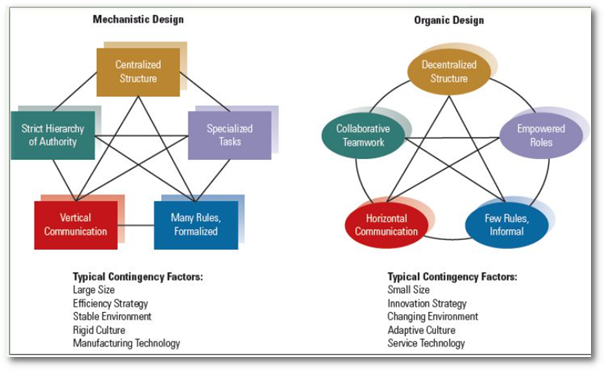
- The traditional hierarchical structure is obsolete therefore an organic or circular framework that utilizes a decentralized system is required. This is called organizational transformation which affects the structure and the strategy.
- Both the local business and community model will use the organic circular or decentralized structure which focuses on human-value and purpose-driven “engagement fulfillment”
- Both Hierarchical or Mechanistic Framework and the Organic Framework are displayed in the Model below:
HAF LOCAL BUSINESS AND COMMUNITY SUSTAINABLE GROWTH SOLUTIONS
SYSTEMS
HAF ENGAGEMENT-FULFILLMENT SOLUTIONS THRU:
PEOPLE-CENTRIC, HUMAN VALUE CORE, PURPOSE-DRIVEN, WELLNESS-SAFETY, ONGOING TRAINING, SHARED-DECISION, HYBRID SCHEDULE
HAF advisors provide a strong business and community foundation for:
Local businesses
- new workforce social standards and practices that will help small businesses thrive and be resiliently sustainable
- a workforce and management engagement-fulfillment system
- ongoing gap performance systems of all new standards and practices and engagement-fulfillment
- new education knowledge and skill set new through apps
- wellness apps
- ongoing workforce and management surveys for insight readiness and improvements
Local communities
- new community social engagement-fulfillment systems and ongoing gap performance systems
- new social standards and practices for civic, educational and resource protection
- new public educational knowledge and skill sets for wellness
- ongoing community member surveys for insight readiness and improvements
- ongoing gap performance systems of public services and infrastructure
These public advisory services will solve the outdated organizational systems with social engagement- fulfillment systems now recognized as the number one solution for SME and local communities’ sustainable growth. Building this foundation requires new “social” standards and practices which prove successful in the engagement-fulfillment strategy.
HAF advisors provide the relief to the survival of small businesses through its public service advocacy with the installation and delivery of long needed relief to the workforce whose health, safety and recognition-belonging is of paramount importance as shown in the workforce population shortages and lack of sustainable growth. Utilizing a lower cost-effective social fulfillment system of the workforce population focus through “human-value and purpose-driven” people centric organic systems solves the workforce needs for small business owners who continue to manage inflation and other economic headwinds.
The outdated organizational systems used by SME and big businesses have been to leverage their workforce through a time-measured engagement of performance which the recent pandemic negatively impacted causing the multi-generational workforce to re-focus into a need of health, safety and upgrading workforce knowledge and skill sets across all 4 business organization sectors. The workforce population of Millennials, occupying 75% of the workforce, and Generation Z, growing to 27% in 2025, require sustainable, engagement-fulfillment solutions to resolve these needs which cannot be resolved by higher wages. Higher wages strategy for small businesses negatively impacts revenue and profit sustainable growth.
A July 2022 recent survey from the National Federation of Independent Business found that about half of small-business owners said in July they still can’t fill open jobs, a near-record high in the survey’s roughly five-decade history. https://www.nfib.com/content/press-release/economy/nfib-jobs-report-nearly-half-of-small-business-owners-still-cant-fill-job-openings/
July 2022 Survey by NFIB : Business owners reported:
- 21% top problem being labor
- 9% labor costs top business problem
- 64% hiring efforts resulted in 91% of the 64% no qualified applicants
- 48% increased compensation rates
HAF advisors implement both the engagement-fulfillment systems and SGMS, an ongoing gap management system to identify, remove and prevent the engagement-fulfillment and organization’s performance fulfillment gaps. Job enrichment is at the core of the engagement-fulfillment system.
Business and community sustainable growth problems are based on outdated industrial revolution business standards and practices which do not sustain the current large millennial and coming Gen Z workforce population. With the rise of digital technology, manufacturing industry mostly transferred to China resulting in SME focus on IT, services, retail and suppliers.
HAF Board Advisory SGMS IT-apps “insight-ready metric” programs, survey-fitted with an API (interface), building a daily collective hi-performing engagement-fulfillment level in the following areas:
-
- Local community member engagement-fulfillment and gap performance systems
-
- Public services gaps reduction and prevention
- New social engagement education and practices for all members
- Leadership focus on member human value core and collective unity purpose-driven
- Local business and community engagement-fulfillment
-
- Local business workforce engagement-fulfilment with gap performance systems
-
- market, customer, supply-chain connectivity, local community, local educational institutions connectivity and alignment
- workforce shared human-core values culture
- workforce shared-vision and purpose-driven culture
- workforce performance-engagement culture
-
- Local community member engagement-fulfillment and gap performance systems
ORGANIC SYSTEMS
FRAMEWORK
CIRCULAR FRAMEWORK
*AN ORGANIC SYSTEM OF PERFORMANCE*
Hierarchy of “inequality” removed
Systems are the alignment and management of processes in each and between all sectors of the framework. SGMS identifies, measures, removes and prevents all the gaps in the systems’ processes within the core flow and connectivity.
The FRAMEWORK is organic and circular which collectively engages, connects, and performs the connective-flow of the human-value and purpose-drive framework system and outcomes
throughout small businesses and communities
local business finance, marketing, operations and management/ownership
local community administration, public services, finance, public education
CIRCULAR FRAMEWORK CORE; Local Business and Community
Sustainable growth is the alignment of all core internal & external connectivity and system processes
Core “organic” internal-external “collective” connectivity and flow of leadership/advocates, people performance & engagement fulfillment
Core “organic” internal-external “collective” connectivity to the collective performance and outcomes
LOCAL BUSINESS AND COMMUNITY FRAMEWORK
ENGAGEMENT-FULFILLMENT
CONNECTIVITY & ALIGNMENT-FLOW MODELS
Flow & Connectivity (Internal-External) Alignments, Disconnections and Gaps
Local Business
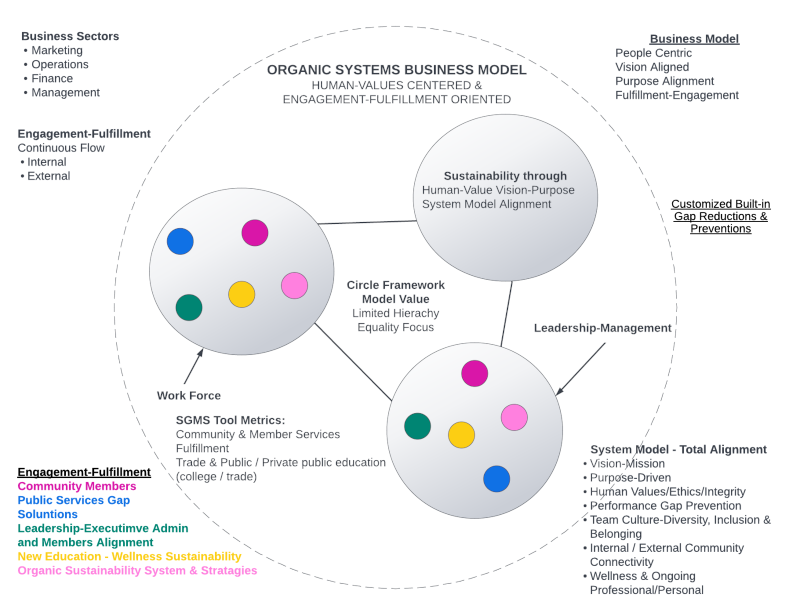
Local Community
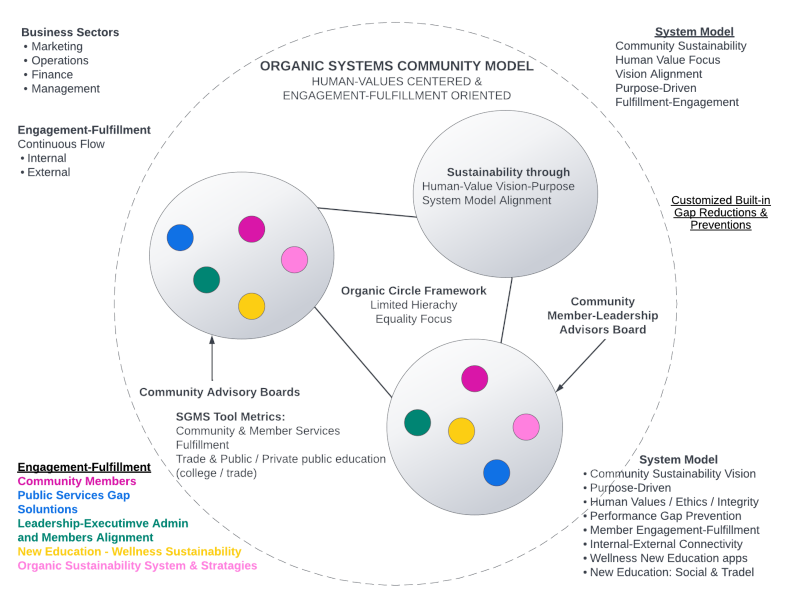
SGMS metrics identifies, removes and prevents all the gaps that
obstruct the flow and between each connection
Local Business and Community core model connectivity and alignment flow and gap systems
FRAMEWORK CORE: Human values, purpose-driven with engagement-fulfillment
Sustainable Growth: SGMS Identifies, removes and prevent gaps to achieve desired longevity of business and community engagement-fulfillment
Local business: Internal Connectivity, Alignment and Flow
- Local business organization’s internal model engagement-fulfillment system
- Human-value focus and purpose-driven collective workforce internal operations
- External business organization’s external engagement-fulfillment system
- Human-value and purpose-driven engagement-fulfillment system with local community sustainable growth
HAF Engagement-Fulfillment Solution Strategies:
-
- People-equality, human valued-core, purpose-driven
- Diversity, equity, inclusivity, team culture-belonging, shared-decision making, autonomy-hybrid schedule options
- Health & Safety : online apps for daily Wellness and Safety practices
- Ongoing professional development (knowledge and skill sets)
- Frequent surveys(anonymous) and assessments
- People-equality, human valued-core, purpose-driven
SUSTAINABLE GROWTH OF ENGAGEMENT-FULFILLMENT
SGMS MANAGEMENT SYSTEMS
Organization’s Core Framework Alignment Model
Local Business Sustainable Growth & Engagement Fulfillment Requirements
-
- Vision, Purpose & Mission-Drive: Human Values Core-Driven
- Human Values Core-Driven – Internal & External Alignment
- Internal Alignment – Business Ownership. Management, Marketing, Finance, Operations, Workforce-Stakeholders
- External Alignment – Market, Local Community, Vendors-Suppliers, Educational Institutions
ORGANIC SYSTEMS: FRAMEWORK ALIGNMENT
SUSTAINABLE GROWTH
SGMS MANAGEMENT SYSTEMS
Organization’s Frame Core Alignment Model
Local Community Sustainable Growth & Engagement-Fulfillment Requirements
-
- Vision, Purpose & Mission-Drive: Human Values Core-Driven
- Human Values Core-Driven – Internal & External Alignment
- Internal Alignment – Community Members Engagement-Fulfillment
- Administration (Management/Finance/Operations)
- Public Relations- Ongoing Surveys
- Public Services Admin– Ongoing Surveys
- Engagement-Fulfillment of community members
- Administration (Management/Finance/Operations)
- External Alignment – Resources
- Local Member Trade, Local Community, Vendors-Suppliers, Higher Educational Institutions
- Outer External Alignment – State Support (Educ, Infrastructure)
- Final Outer External Alignment – Federal Support (Educ, Infrastructure)
- Internal Alignment – Community Members Engagement-Fulfillment
MILLENIALS & GEN Z : Business and community sustainable growth problems are based on outdated industrial revolution business standards and practices which do not sustain the current large millennial and coming Gen Z workforce population. With the rise of digital technology, manufacturing industry mostly transferred to China resulting in SME focus on IT, services, retail and suppliers.
- (SME) Small businesses drive 44% of the economic activity in the United States. There are 30.7 million small businesses in every industry, from hospitality to construction. (ownership is 8.9% of US population) (Revenue $1MM-$40MM)
- SME are non-subsidiary, independent firms which employ fewer than a given number of employees with frequent upper limit of 250 employees
- 200,000 medium-sized businesses in the USA (Revenue $1MM- $1BB (Forbes 2018)
2022 + PREDICTIONS TRUE:
Flexible work schedule: The predictions describing employee expectation challenging employer capabilities is absolutely coming true, particularly with respect to flexible work structures. We continue to see a tug of war between employers who want people back in the office and employees who have gotten accustomed to managing their lives with remote work. It’s difficult because some jobs actually need to be done in person, but these employees understandably want greater flexibility too and to avoid existing burnout.
HAF system model adaptation for business manager mentorship or coaching for Gen Z is required. This is critical for talent retention due to the Gen Z personality workforce needs. Currently, there really isn’t much of an organizational infrastructure beyond the typical employee assistance programs (EAPs).
As we approach the last quarter of 2022, people are stressed about work and their challenging mental health, the distress negates their need for job security. Coupled with the historical economic and familial instability Gen Z does is not a dependable workforce unless there is a business fulfilment model. Since this workforce population is now onboarding its instability without fulfillment will produce “greater business market deaths” which cannot be circumvented.
Since Gen Z workforce population is now onboarding its current hiring retention challenges (without engagement-fulfillment) will continue “business deaths” that include but not limited to:
- Job opening remain high
- Job quit rates remain high
- Employee turnover will continue without the prescribed fulfillment model
- Burnouts continue due to high stress loads
- Increased compensation remains
- Continued hiring challenges due to flexible work schedules demands (remote and hybrid
HAF Engagement-Fulfillment Systems (SGMS) will satisfy:
- High demand for ESG (Environmental, Social and Governance) incomplete
- CSR (corporate social responsibility programs) increasing
- Workforce and leadership / management need to share the same values (workplace safety, learning upgrades and people-centric experiences through surveys (HCM self-service options, town halls and focus groups)
- Active listening by management, leadership and HR required
- Improving employee learning and skill sets offset the negatives
- Diversity and inclusion are appreciated
- The feeling of belonging pays dividends for businesses
HAF can incorporate current business and community apps for professional and wellness new education online access through a nominal charge of (under $20/per person). This nominal fee can be shared by workforce and or community members.
PANDEMIC IMPACTS ON US AND ARKANSAS BUSINESSES & WORKFORCE
 https://www.armoneyandpolitics.com/small-business-numbers/
Although Arkansas is home to several Fortune 500 companies, the vast majority of companies in the state are small businesses. Despite their small size, these companies collectively contribute almost half of the labor force to the state’s economy and have a significant economic impact both at home and on a global scale. First, it’s important to define what a small business is. Due to federal size standards, small businesses can range in size from one employee to, in some cases, up to 1,500 employees.
ARKANSAS PREDICTIONS : https://www.axios.com/local/nw-arkansas/2022/01/31/6-predictions-for-arkansas-economy-in-2022
• Arkansas will add 20,000 jobs this year. The state added 27,000 jobs in 2021 after losing 38,000 jobs in 2020, he said.
• People are leaving jobs at small businesses for jobs in big businesses
• Wages are rising but are not keeping up with inflation.
• The state’s unemployment rate is 3.1%, compared to the national rate of 3.9% at the end of 2021, which will likely continue being a double-edged sword for the state’s staffing shortage woes. (Go deeper on NWA’s record-low unemployment rate.)
• Pandemic-related childcare struggles including daycares shutting down and quarantines continue to disproportionately affect women in Arkansas. Fourteen percent of moms with kids under 6 years old quit their jobs in 2021 because of childcare, compared to 5% of fathers.
Arkansas Ranks 2nd for Most Pandemic-Proof Small Businesses –
https://dws.arkansas.gov/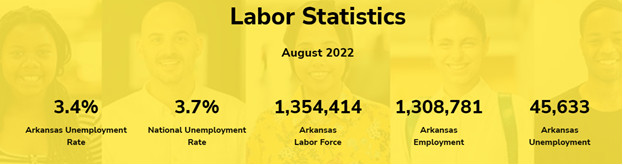
August 2022 Report:
Inflation Eases For Some Small Businesses But Remains A Serious Problem https://www.nfib.com/surveys/small-business-economic-trends/
_____________
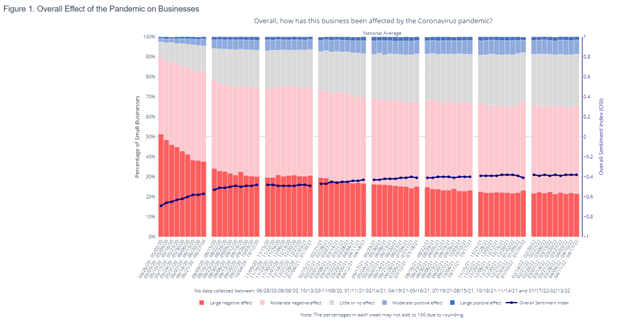
https://portal.census.gov/pulse/data/
THE US EMPLOYMENT SITUATION AUG 2022: https://www.bls.gov/news.release/pdf/empsit.pdf
The impact of COVID-19 on small business outcomes and expectations https://www.pnas.org/doi/10.1073/pnas.2006991117
Small Business Pulse Survey Updated July 6th, 2022 – https://portal.census.gov/pulse/data/#research
https://www.census.gov/programs-surveys/abs/newsroom.html https://portal.census.gov/pulse/data/#research
The percentage of U.S. small businesses reporting decreases in revenues in the last week decreased from 40.4% in SBPS Phase 3 (1/4/2021 – 1/10/2021) to 33.0% in SBPS Phase 7 (1/3/2022 – 1/9/2022). – https://www.census.gov/library/stories/2022/03/mom-and-pop-businesses-key-contributors-to-united-states-economy.html
Organizations, big and small, are stepping up efforts to address employees’ mental health, from offering one-on-one counseling through employee assistance programs to providing access to virtual therapy and meditation apps for free.
Some companies, including energy giant BP, are including questions about employees’ mental wellbeing in regular employee surveys to better understand how teams are feeling in real-time.
Starbucks is offering free virtual therapy to address everything from stress and anxiety to depression. Bank of America is providing telemedicine options for behavioral health and access to a free online and mobile mindfulness app to support emotional wellness.
And for workers looking for help beyond their employer, LinkedIn Learning has courses on supporting your mental health while working from home, dealing with grief loss and change, and having an inclusive mindset.
COVID-19 prompted about 30% of employed adults to take a leave of absence, according to a new World Economic Forum-Ipsos survey.
• 56% experienced increased anxiety around job security.
• 55% found changes in work routines and organization stressful
• Almost half of all surveyed felt lonely or isolated when working from home
• More than 40% said their productivity fell and it was hard to get work done at home.
https://www.ncbi.nlm.nih.gov/pmc/articles/PMC7792911/
Recent surveys of national representative samples showed the adverse mental health consequences during COVID-19 lockdown [6, 7]. For example, in mid-June 2020, prevalence of anxiety (25.5%) and depression (24.3%) was substantially higher than national estimates from the 2019 US National Health Interview Survey (6.6% for anxiety and 8.2% for depression) [6, 8]. Also, the rates of anxiety or depression during COVID-19 showed clear gradient and even worsening disparity across different demographic and socioeconomic groups, including a higher level of the mental disorders linked with younger age, female, race/ethnicity other than nonHispanic white and nonHispanic Asian, lower education, and lower household income [6, 8].
Accessible-2021_SEED_WorkersMentalHealth_Report-11_22.pdf: https://seed.csg.org/wp-content/uploads/2022/01/Accessible-2021_SEED_WorkersMentalHealth_Report-11_22.pdf

https://www2.deloitte.com/us/en/insights/economy/impact-of-covid-on-women.html
2022 TRENDS REPORT – https://www.apa.org/monitor/2022/01/special-workforce-losses
Millions of women have left the workforce. Psychology can help bring them back
The COVID-19 pandemic exposed the tenuous economic, societal, and community infrastructure for women working outside of the home.
https://www.apa.org/monitor/2022/01/special-workforce-losses
ENGAGEMENT-FULFILLMENT SURPASES FORMER WORKFORCE ENGAGEMENT BUSINESS MODEL
The pandemic losses to businesses continue as workplace has little safety to maintain the on-site workplace requirement. Health safety has not been solved.
Engagement-Fulfillment is a “people-centered workplace focus ”that surpasses ‘engagement-fulfillment'”. Workplace engagement is a day to day or project to project engagement that may or may not transfer to a “lasting engagement”. Engagement-Fulfillment describes both the company and employee achieving a lasting state of satisfaction and productivity due to the incorporation of “important personal or individual and collective human values”. This type of employment contract or promise has lasting implications as it drives the engagement-fulfilment of both the company and workforce through an internal and external purpose of “service to others” alignment.
Service to others describes what a business model typically strives to produce in products and services. Customer loyalty can wane, be sustained or increase. Loyalty is the result of the comprehensive business service understanding of its customers. Lasting loyalty is determined by successfully adapting to the needs of the customers. Employee loyalty uses the same “service to others” and requires a comprehensive understanding to serve the needs of its employees. Employee productivity and retention is the result of fulfilling the learning and well-being needs.
The business and local community engagement-fulfillment model moves beyond the “engagement” business or normal community model. The engagement business model normally does not lend itself to employee fulfillment which creates a performance “moving target” result. Engagement-Fulfillment applies to the leadership, workforce and local community to ensure lasting business success.
For some companies, a proactive, people-centric, and socially conscious approach is a priority. For other companies, difficult short-term concerns will drive their actions.