
ORGANIC CHANGE FULFILLMENT MODELS
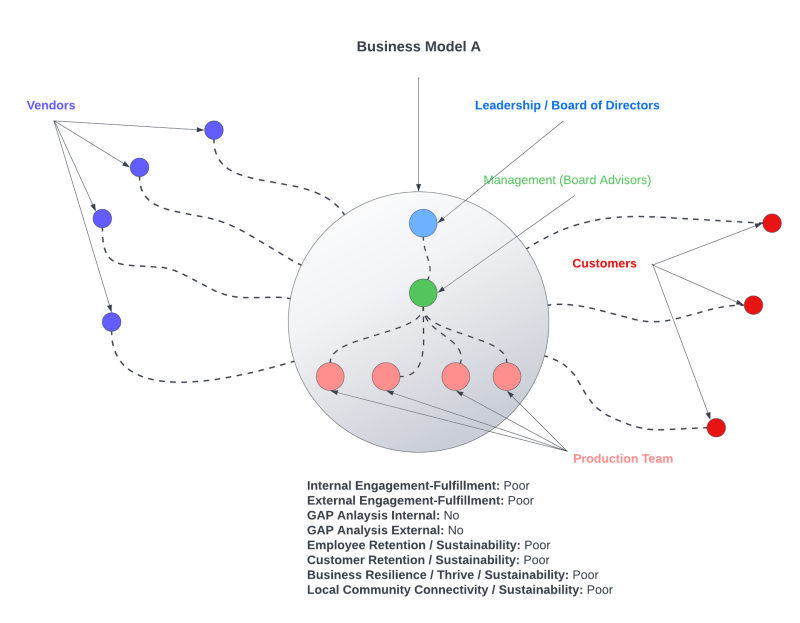
Business Model A is a worst case example. Engagement-fulfillment throughout the company (plus with vendors and clients) is pretty chaotic. Due to this environment, there is little chance that the business will be able to continue long term unless significant changes are made.
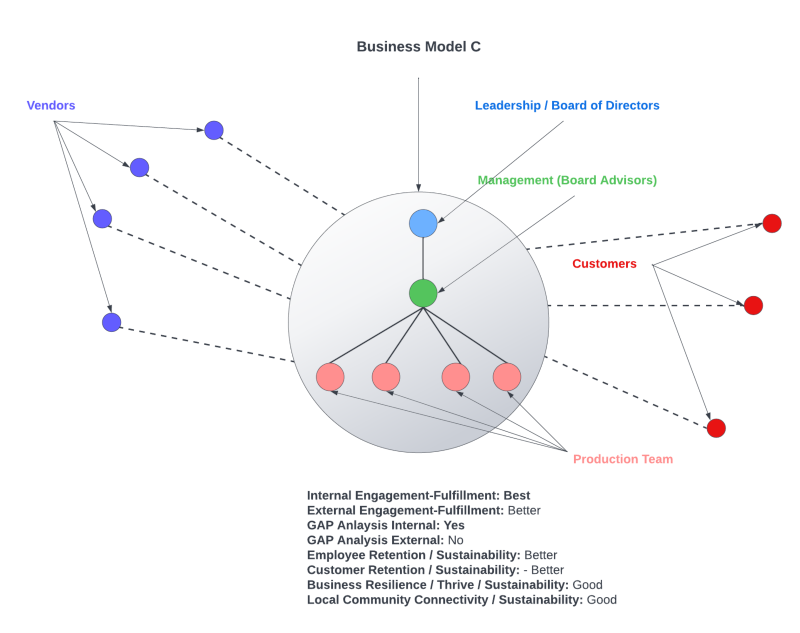
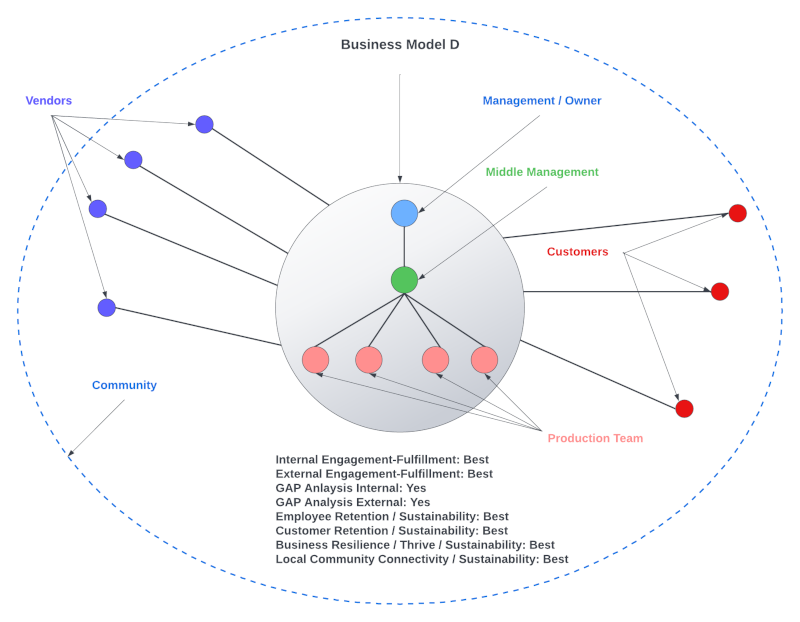
In Business Model C, you are seeing a vast improvement (internally) due to the the implementation of the GAP Analysis tool. This tools allows “objective” measurements in areas that were once only “subjective” and thus no way to really measure the difference.
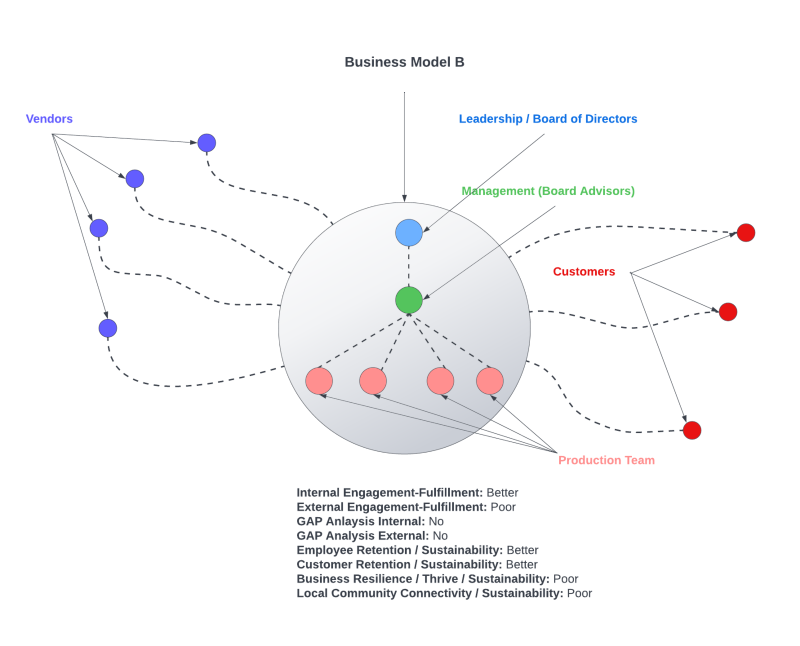
With Business Model B, engagement-fulfillment has improved but there is an inability for further improvement due to a lack of measurement tools to bring the evaluation process from “subjective” to an “objective” approach. This type of tool simply has not existed in the marketplace.
HAF FRAMEWORK MODEL
HAF assesses each organization’s framework and organizes a change in the business framework model to accommodate sustainability through engagement and human fulfillment.
Due to the market’s instability, it is best to organize an organic cultural change into the organization’s framework to stabilize and sustain workforce. Due to the current problematic workforce health safety concerns, mental stability challenges and Gen Z due to occupy a larger workforce population it is best to begin an organic cultural change process to guarantee sustainability in the near and further future.
HAF recommends the utilization a strong organic framework with agreed functional mechanistic framework to achieve the sustainability changes desired more easily.
Organizational structure is a type of framework used in businesses. Its purpose is to find the most effective way to delegate roles, power, and responsibilities to its employees and departments.
It also controls and coordinates how information flows between different departments and levels of management in an organization. Having a proper organizational structure will allow a company to implement better operating procedures, and dictate which employees help in making decisions or shaping the organization. Based on an organizations goals and objectives it may be structured in many ways
HAF begins with these questions to expand the business owner, leaders, or management awareness of the importance of the business framework model:
- Will your business sustainability strategies guarantee your required business needs if the market instability continues?
- Are you sustaining workforce needs currently and into the future?
- How will your structure work successfully with Gen Z workforce?
- Is your structure flexible to adapt quickly to the market rate of changes today and in the future.
- Is the problem the structure or the way management is managing it?
- Does the structure match out strategy?
- Has organization design been compromised due to accommodating to personalities?
Mechanistic and Organic Design
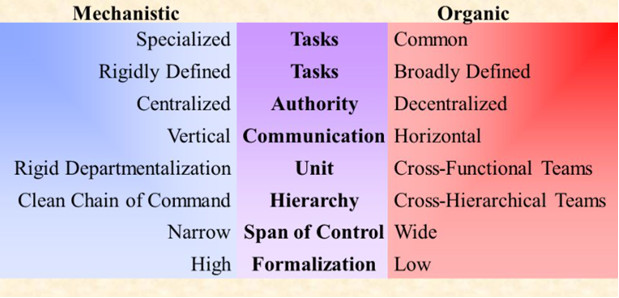
The “mechanistic” organization’s framework
Mechanistic structures are mainly for companies that operate in a stable environment, use a centralized approach of authority, and maintain strong loyalty for management. Organizations that use a Mechanistic type of structure generally do not need to change or adapt their structure. This is mainly due to lack of innovation, creativity, and quick decision analysis not needed. Examples of organizations using Mechanistic structures include colleges and universities. If you think about it, they have long and strict registration procedures, rarely have to adapt or change in order to keep students enrolling, and most students tend to maintain high loyalty or obedience toward their instructors.
Key take-aways:
– Belief upper management is better capable of making decisions
– Management instructions must be followed
– Communication and control must proceed through hierarchical routes
– More emphasis toward completing a task opposed to achieving company goals
– Employees are more jobs specialized and placed into certain departments
– Low differentiation of tasks
Mechanistic Structures Include:
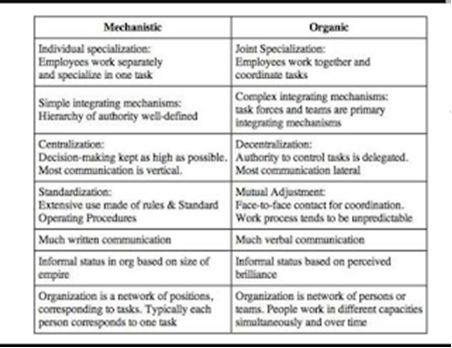
The “Organic” organizational framework
Organic structures are used in organizations facing unstable environments and must possess the ability to change accordingly. They have the ability to process, analyze, and distribute information and knowledge very quickly. This ensures that they stay competitive against other businesses. Businesses using Organic structures need to communicate effectively and quickly by spreading information. This is done by departments and different functional areas being closely integrated with one another. Also, by implementing decentralized decision making, employees of lower ranking will have the ability to make important decisions. This will help empower employees leading to greater creativity and better problem solving. Google Corporation is a great example of an Organic structure-based business.
Their employees are encouraged to use creative problem-solving skills and develop new products.
Organic Structures Include:
– Large network of authority, control, and communication
– Problem solving is encouraged by all employees
– Employees are more goals oriented than job orientated
– Employee empowerment is encouraged
The structure of an organization will dictate how people interact with each other and their relationship of roles in the organization. If a structure is outdated or not implemented correctly in a business, it will lead to many problems. These include conflict among employees or departments, confusion of employee roles, and lack of communication / coordination among departments.
In the past managers have simply tried to reorganize or work with the current structure of a business rather than addressing the necessary issues. This could lead to greater complexity rather than solving structural flaws.
HAF LOCAL BUSINESS AND COMMUNITY SUSTAINABILITY SOLUTIONS
SYSTEMS
HAF ENGAGEMENT-FULFILLMENT SOLUTIONS THRU:
PEOPLE-CENTRIC, HUMAN VALUE CORE, PURPOSE-DRIVEN, WELLNESS-SAFETY, ONGOING TRAINING, SHARED-DECISION, HYBRID SCHEDULE
HAF Board Advisory services upgrade outdated business standards and practices with HAF SGMS IT “insight-ready metric” programs, survey-fitted with an API (interface), building a daily collective hi-performing engagement-fulfillment level in the following areas:
- Business and market alignment
- Business and workforce shared human-core values culture
- Business and workforce shared-vision and purpose-driven culture
- Business and workforce performance-engagement culture
- Business-workforce engagement-fulfillment culture
HAF SOLUTIONS SYSTEMS, METRICS (SGMS) & STRATEGIES
HAF solutions offer public service advisory services for each business sector and nominal digital solutions to upgrade with the installment of new business standards & practices create engagement-fulfillment.
- ALIGNMENT OF HUMAN-VALUE CORE, PERFORMANCE & ENGAGEMENT FULFILLMENT
- HAF CIRCULAR FRAMEWORK MODEL
- NEW EDUCATION & WELLNESS APPS
- Circular Framework Model: Organizational Structure, Human-Value Core, Systems, and Gap Metrics
CIRCULAR CHART MODELS; Local Business and Community
- Local Business Model
- Local Community Model
Sustainability is the alignment of all core internal & external connectivity and system processes
Core “organic” internal-external “collective” connectivity and flow of leadership/advocates, people performance & engagement fulfillment
Core “organic” internal-external “collective” connectivity to the collective performance and outcomes
LOCAL BUSINESS AND COMMUNITY ALIGNMENT-FLOW MODELS
Flow & Connectivity (Internal-External) Alignments, Disconnections and Gaps
SUSTAINABILITY & ENGAGEMENT FULFILLMENT
SGMS MEASUREMENT SYSTEMS
Core Framework Alignment Model
Local Business Sustainability & Engagement Fulfillment Requirements
- Vision, Purpose & Mission-Drive: Human Values Core-Driven
Human Values Core-Driven – Internal & External Alignment- Internal Alignment – Business Ownership. Management, Marketing, Finance, Operations, Workforce-Stakeholders
- External Alignment – Market, Local Community, Vendors-Suppliers, Educational Institutions
Local Community Sustainability & Engagement-Fulfillment Requirements
- Vision, Purpose & Mission-Drive: Human Values Core-Driven
Human Values Core-Driven – Internal & External Alignment- Internal Alignment – Community Members Engagement-Fulfillment
- Administration (Management/Finance/Operations)
- Public Relations- Ongoing Surveys
- Public Services Admin– Ongoing Surveys
- Engagement-Fulfillment of community members
- Administration (Management/Finance/Operations)
- External Alignment – Resources
- Local Member Trade, Local Community, Vendors-Suppliers, Higher Educational Institutions
- Outer External Alignment – State Support (Educ, Infrastructure)
- Final Outer External Alignment – Federal Support (Educ, Infrastructure)
- Internal Alignment – Community Members Engagement-Fulfillment
This process focuses on the internal processes of each local community service functionality for “connective efficient functionality” and local member needs fulfillment. HAF systems will improve user friendly accesses provide a detailed blueprint and gap installation system that will identify, remove, solve and then prevent gaps.
HAF uses a circular organizational framework to apply the engagement-fulfillment model for local business and community
Local Business
Local Community
SGMS metrics identifies, removes and prevents all the gaps that
obstruct the flow and between each connection
CORE FLOW: Connectivity and Alignment
Local Business and Community
CORE: Human values, purpose-driven with engagement-fulfillment
Sustainability: Identify, remove and prevent gaps to achieve desired longevity of market performance
Internal-External Flow & Connectivity with people, systems, relationships, performance, engagement-fulfillment, market outcomes, or community member engagement-fulfillment
External Flow & Connectivity with market or community member relationships and market or community demand response
HAF Engagement-Fulfillment Solution Strategies:
- People-equality, human valued-core, purpose-driven
- Diversity, equity, inclusivity, team culture-belonging, shared-decision making, autonomy-hybrid schedule options
- Health & Safety : online apps for daily Wellness and Safety practices
- Ongoing professional development (knowledge and skill sets)
- Frequent surveys(anonymous) and assessments
Business and community sustainability problems are based on outdated industrial revolution business standards and practices which do not sustain the current large millennial and coming Gen Z workforce population. With the rise of digital technology, manufacturing industry mostly transferred to China resulting in SME focus on IT, services, retail and suppliers.
- (SME) Small businesses drive 44% of the economic activity in the United States. There are 30.7 million small businesses in every industry, from hospitality to construction. (ownership is 8.9% of US population) (Revenue $1MM-$40MM)
- SME are non-subsidiary, independent firms which employ fewer than a given number of employees with frequent upper limit of 250 employees
- 200,000 medium-sized businesses in the USA (Revenue $1MM- $1BB (Forbes 2018)
not support the generational workforce and small businesses. (Note! 3 industrial revolutions of steam engine, the age of science and mass production)
NEW BUSINESS STANDARDS AND PRACTICES: Require engagement-fulfillment of the current and future predominant millennials and Gen A which is human-value centered, purpose-driven and team culture-based. Post pandemic economic instability with unwilling workforce hiring-retention will not sustain the SME without a sustainable supply of workforce which thrives in an organic model structure and systems.
Local Community Sustainability & Fulfillment: This process focuses on the internal processes of each local community service functionality for “connective efficient functionality” and local member needs fulfillment. HAF systems will improve user friendly accesses provide a detailed blueprint and gap installation system that will identify, remove, solve and then prevent gaps.
HAF ORGANIC BUSINESS AND LOCAL COMMUNITY SYSTEMS, PROCESSES AND MODELS.
HAF uses a spherical system organizational chart – see here:
All types of businesses are assessed for optimal performance using processes to minimize gap and maximize sustainable proficiency. Maximum gap is at 5% with slight deviation across other business or community departments.
- Start-up
- Small businesses
- Medium businesses
- Local communities
Note! Both start-ups and local communities are equipped to perform self-sufficiently. (not totally automated)
HAF performs both a preliminary and comprehensive assessment. As a public service Board Advisor to businesses and local communities we offer HAF preliminary assessment scholarships to leaders, CEO, executives and entrepreneurs to across Arkansas. This assessment will provide a “finger-on-the-pulse” on your business or entity overviewing business gaps, systems and processes for resilient sustainability and growth. Please follow this link to access your complimentary preliminary business assessment.
Once HAF receives your submission your assessment evaluation will be scheduled for online zoom conference time. The market value of this is $1500 offered as a free public service. (Note! We can use the questioning model (gap) that I sent you early on and include the CEO one as well)
CIRCULAR – SPHERICAL
The center of this sphere will be the core human values. These values are purpose-driven to fulfill all members throughout the sphere applied through a meritocratic system.
There are 2 models that include the basic start-up, entrepreneurial and small business and the second model is dedicated to medium and large businesses. This model will also serve as a continuous “filtering” process which prevents stagnation and achieves maximum proficiency, growth, resiliency and sustainability.
Sphere Direction:
Level one: The workforce arc is next to the center and moves outward. This flow system maintains the integrity of the core human values as well as the vision and mission of the Company which will interface with the local community.
Level Two: The manager arc is organically transformed into a mentor-coach to fulfill the needs of both the workforce and company. This fills the generational Z gap workforce performance gaps. The manager will provide orientation, education, training and assessments to the workforce and interface with both community interns and Level Three.
Level Three: A Systems Analyst will take over the manager’s tasks on performance-fulfillment gap assessments as well as apply required education and skill set training data sets relative to workforce performance gaps into an educational fulfillment program for the manager to execute.
Level Four: Business or Community Board Advisor – The function of this position will inspire solutions, innovations, insights and strategies with continuous review, mentor-coaching and planning with the Level Three and Two as well as interface with Level 5.
Level Five: Company Board of Directors – The Directors functions in various capacities of all Levels. The most important value is to maintain the core human-values and community values on a daily-basis. As compassionate visionary leaders their greatest value is to protect the solidarity of both the company and workforce as part of the whole community.
Their proficiency lies in being able to foresee the future trends, identify the critical paths with both risk mitigation and build trusting relationships which will support the life and vision of the Company and its community. Expansion and mergers to thrive are part of this strong planning and forecasting function.
Finally, policies and procedures are reviewed from all levels with special focus in Level Five which may include updating and adding those that are relevant to thrive and fulfill all members.
HAF business system and model are applied to all business models.
HAF “organic change” model is designed, constructed and executed once the current model performance gaps are evaluated in all areas. Systems are designed with processes to remove current gaps and prevent future gaps.
Gaps appear in business systems and processes both internally and externally. Gaps are created when the current business condition does not meet the agreed goals or outcomes. They grow higher when left unchecked. During current economic instability the gaps must be measured frequently to avoid critical thresholds which threatens the life blood of the business.
These are just a sampling of gaps that include the following:
1. Workforce peers
2. Workforce teams
3. Workforce performance and business capabilities for sustainability/growth
4. workforce and management
5. management and operations
6. business operation and revenue-net profits
7. business and its customers
8. business and its suppliers
9. business and its resources
10. business and its market standing (brand)
11. business and community
12. business purpose and mission
13. business purpose and vision
14. leadership and workforce
15. leadership and management
HAF performs gap analyses across all business sectors.
COST MODEL FOR NO EMPLOYEES CORPORATIONS TO BE ORGANIZED
HAF Workforce surveys will be implemented to assure the best formulation of workforce needs and fulfillment for all stakeholders. The cost factor is negligible due to the replacement or inability to fill and sustain the job positions.
In late summer of 2022, there are ten million jobs available with job hires low. People are not willing to take the jobs because they are not safe for the worker and worker family due to the pandemic. Early retirements have accelerated resulting in a double jeopardy situation. Environmental concerns is another social cultural demand which increases factors to disturb business stability.
FULFILLMENT SURPASES FORMER WORKFORCE ENGAGEMENT BUSINESS MODEL
The pandemic losses to businesses continue as workplace has little safety to maintain the on-site workplace requirement. Health safety has not been solved.
Fulfillment is a “people-centered workplace focus” that surpasses “engagement”. Workplace engagement is a day to day or project to project engagement that may or may not transfer to a “lasting engagement”. Fulfillment describes both the company and employee achieving a lasting state of satisfaction and productivity due to the incorporation of “important personal or individual and collective human values”. This type of employment contract has lasting implications as it drives the fulfilment of both the company and workforce through an internal and external purpose of “service to others” alignment.
Service to others describes what a business model typically strives to produce in products and services. Customer loyalty can wane, be sustained or increase. Loyalty is the result of the comprehensive business service understanding of its customers. Lasting loyalty is determined by successfully adapting to the needs of the customers. Employee loyalty uses the same “service to others” and requires a comprehensive understanding to serve the needs of its employees. Employee productivity and retention is the result of fulfilling the learning and well-being needs.
The business fulfillment model moves beyond the “engagement” business model. The engagement business model normally does not lend itself to employee fulfillment which creates a performance “moving target” result. Fulfillment applies to the leadership, workforce and local community to ensure lasting business success.
For some companies, a proactive, people-centric, and socially conscious approach is a priority. For other companies, difficult short-term concerns will drive their actions.
2022 + PREDICTIONS TRUE: The predictions describing employee expectation challenging employer capabilities is absolutely coming true, particularly with respect to flexible work structures. We continue to see a tug of war between employers who want people back in the office and employees who have gotten accustomed to managing their lives with remote work. It’s difficult because some jobs actually need to be done in person, but these employees understandably want greater flexibility too and to avoid existing burnout. Business manager mentorship or coaching for Gen Z has not been implemented. This is critical for talent retention due to the Gen Z personality workforce needs. Currently, there really isn’t much of an organizational infrastructure beyond the typical employee assistance programs (EAPs).
As we approach the last quarter of 2022, people are stressed about work and their challenging mental health, the distress negates their need for job security. Coupled with the historical economic and familial instability Gen Z does is not a dependable workforce unless there is a business fulfilment model. Since this workforce population is now onboarding its instability without fulfillment will produce “greater business market deaths” which cannot be circumvented.
- Job opening remain high
- Job quit rates remain high
- Employee turnover will continue without the prescribed fulfillment model
- Burnouts continue due to high stress loads
- Increased compensation remains
- Flexible work schedules (remote and hybrid in demand)
- ESG (Environmental, Social and Governance) are continuing to be established
- CSR (corporate social responsibility programs) increasing
- Workforce need to share the same values (workplace safety, learning upgrades and people-centric experiences through surveys (HCM self-service options, town halls and focus groups)
- Active listening by management, leadership and HR required
- Improving employee learning and skill sets offset the negatives
- Diversity and inclusion are appreciated
- The feeling of belonging pays dividends for businesses
The nominal under $20/per person business fulfillment model is the only safety net and its cost is negligible as market business death is looming nearby.
HAF BUSINESS PERFORMANCE & WELL -BEING FULFILLMENT MODEL
After extensive pandemic impacts on businesses and the business next business generational model need to focus on business performance and workforce fulfillment HAF has organized solutions that contribute to positive impacts for local businesses and communities both in Arkansas and US.
Business engagement has left businesses struggling after the pandemic impacts. This is due to the fact that engagement centers its focus on business market performance. Large corporations are implementing a culture that is human-value-centered with wellness programs. Small businesses are following yet not fully onboard for “today’s post pandemic safety, business ongoing learning systems, mental-health and fitness vitality needs to sustain and thrive.
This business model has been just another “post-industrial” ghost that is over 70 years old and is currently being slowly replaced by a culture of; diversity-inclusion, human-value core alignment with engagement, ongoing knowledge & skill sets as well as a full wellness program (mental-physical vitality and fitness).
HAF has organized a comprehensive “performance gap solution model” to address the long standing and little understood missing performance gaps.
HAF builds a future healthy and thriving workforce through diversity-inclusion, human-value and ongoing learning engagement and body-mind wellness. Becoming a health organization is critical for improving employee retention and fulfillment.
During the past two years of intense uncertainty, leading companies have realized the impact that mental and emotional thriving can have on inspiring overall performance. For innovative talent leaders, employee well-being is not about perks and benefits — it’s a critical part of overall strategy.
Post pandemic workforce concerns center on health safety for the worker and worker’s family as well as mental fitness sustainability and ongoing business professional development.
These concerns have been solved through HAF R & D within its Advisor Board platform, fulfillment model resources, and new market apps. Small business and non-employee businesses are the primary targets for HAF solutions. Medium-sized and large businesses will receive Board Advisory public services assistance.
All HAF public services to small businesses, through its Board Advisors programs as well as the performance and well-being fulfillment business model system. This is an organic system approach which focuses on a full alignment with human-values as its core alignment with its business vision, purpose and missions connection to its internal workforce and externally to its local communities.
Further HAF incorporates this organic performance-fulfillment model system to support and sustain a multi-generational workforce:
GEN Z
GEN X
MILLENIALS
BABY BOOMERS RETIRING
Every human in the workforce desires fulfillment of its needs in building learning, skills sets, tools as well as recognition and a sense of belonging. Workforce safety and mental health challenges part of the business performance solutions for its human resources. Once the workforce if fulfilled it protects the business market purpose and desired outcomes. This is a fulfillment culture which when implemented creates a thriving workforce community, customer retention and thriving business market performance.
PANDEMIC IMPACTS ON US AND ARKANSAS BUSINESSES & WORKFORCE
 https://www.armoneyandpolitics.com/small-business-numbers/
Although Arkansas is home to several Fortune 500 companies, the vast majority of companies in the state are small businesses. Despite their small size, these companies collectively contribute almost half of the labor force to the state’s economy and have a significant economic impact both at home and on a global scale. First, it’s important to define what a small business is. Due to federal size standards, small businesses can range in size from one employee to, in some cases, up to 1,500 employees.
ARKANSAS PREDICTIONS : https://www.axios.com/local/nw-arkansas/2022/01/31/6-predictions-for-arkansas-economy-in-2022
• Arkansas will add 20,000 jobs this year. The state added 27,000 jobs in 2021 after losing 38,000 jobs in 2020, he said.
• People are leaving jobs at small businesses for jobs in big businesses
• Wages are rising but are not keeping up with inflation.
• The state’s unemployment rate is 3.1%, compared to the national rate of 3.9% at the end of 2021, which will likely continue being a double-edged sword for the state’s staffing shortage woes. (Go deeper on NWA’s record-low unemployment rate.)
• Pandemic-related childcare struggles including daycares shutting down and quarantines continue to disproportionately affect women in Arkansas. Fourteen percent of moms with kids under 6 years old quit their jobs in 2021 because of childcare, compared to 5% of fathers.
Arkansas Ranks 2nd for Most Pandemic-Proof Small Businesses –
https://dws.arkansas.gov/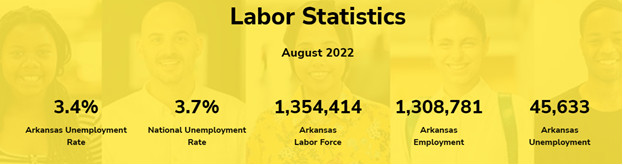
August 2022 Report:
Inflation Eases For Some Small Businesses But Remains A Serious Problem https://www.nfib.com/surveys/small-business-economic-trends/
_____________
https://portal.census.gov/pulse/data/
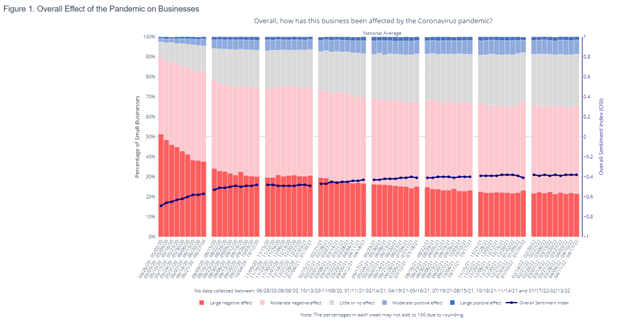
THE US EMPLOYMENT SITUATION AUG 2022: https://www.bls.gov/news.release/pdf/empsit.pdf
The impact of COVID-19 on small business outcomes and expectations https://www.pnas.org/doi/10.1073/pnas.2006991117
Small Business Pulse Survey Updated July 6th, 2022 – https://portal.census.gov/pulse/data/#research
https://www.census.gov/programs-surveys/abs/newsroom.html https://portal.census.gov/pulse/data/#research
The percentage of U.S. small businesses reporting decreases in revenues in the last week decreased from 40.4% in SBPS Phase 3 (1/4/2021 – 1/10/2021) to 33.0% in SBPS Phase 7 (1/3/2022 – 1/9/2022). – https://www.census.gov/library/stories/2022/03/mom-and-pop-businesses-key-contributors-to-united-states-economy.html
Organizations, big and small, are stepping up efforts to address employees’ mental health, from offering one-on-one counseling through employee assistance programs to providing access to virtual therapy and meditation apps for free.
Some companies, including energy giant BP, are including questions about employees’ mental wellbeing in regular employee surveys to better understand how teams are feeling in real-time.
Starbucks is offering free virtual therapy to address everything from stress and anxiety to depression. Bank of America is providing telemedicine options for behavioral health and access to a free online and mobile mindfulness app to support emotional wellness.
And for workers looking for help beyond their employer, LinkedIn Learning has courses on supporting your mental health while working from home, dealing with grief loss and change, and having an inclusive mindset.
COVID-19 prompted about 30% of employed adults to take a leave of absence, according to a new World Economic Forum-Ipsos survey.
• 56% experienced increased anxiety around job security.
• 55% found changes in work routines and organization stressful
• Almost half of all surveyed felt lonely or isolated when working from home
• More than 40% said their productivity fell and it was hard to get work done at home.
https://www.ncbi.nlm.nih.gov/pmc/articles/PMC7792911/
Recent surveys of national representative samples showed the adverse mental health consequences during COVID-19 lockdown [6, 7]. For example, in mid-June 2020, prevalence of anxiety (25.5%) and depression (24.3%) was substantially higher than national estimates from the 2019 US National Health Interview Survey (6.6% for anxiety and 8.2% for depression) [6, 8]. Also, the rates of anxiety or depression during COVID-19 showed clear gradient and even worsening disparity across different demographic and socioeconomic groups, including a higher level of the mental disorders linked with younger age, female, race/ethnicity other than nonHispanic white and nonHispanic Asian, lower education, and lower household income [6, 8].
Accessible-2021_SEED_WorkersMentalHealth_Report-11_22.pdf: https://seed.csg.org/wp-content/uploads/2022/01/Accessible-2021_SEED_WorkersMentalHealth_Report-11_22.pdf

https://www2.deloitte.com/us/en/insights/economy/impact-of-covid-on-women.html
2022 TRENDS REPORT – https://www.apa.org/monitor/2022/01/special-workforce-losses
Millions of women have left the workforce. Psychology can help bring them back
The COVID-19 pandemic exposed the tenuous economic, societal, and community infrastructure for women working outside of the home.
https://www.apa.org/monitor/2022/01/special-workforce-losses
ORGANIC CHANGE FULFILLMENT SYSTEMS
DRIVING RESULTS IN PERFORMANCE INTO ENGAGEMENT-FULFILLMENT
We need to review and edit the website content with the above description which precisely presents how we produce results.
HAF “change” processes focus on the solving the gaps the variety of internal and external processes of each local business and community service function to drive “connective efficient functionality” with local business, workforce and community needs-fulfillment (connectivity).
HAF comprehensive and organic system models yield evidence-based program fulfillment through a step-by-step process of systematic tools for “full alignment with local business and community vision-purpose missions that prove results-driven connectedness with each local community sector (internally and externally).
LOCAL BUSINESS MODEL
continuous improvement with passion-driven focus on the “daily” quality of workplace performance, learning and wellness to engage-fulfill every local business member
using both a science base and practical guidance organic system of processes to engage and fulfill leaders, management, owners and workforce stakeholders into a results-driven engagement and sustainable fulfillment performance
in the HAF “change system process” every person is engaged to contribute as authors and receive the full benefits of their authored engagement
HAF Business Advisors organize and implement various systems that include :
-
- Employ surveys to gain insight and clarification on workforce performance-engagement needs (KPI) for fulfillment
- Multi-generational workforce needs and planning for Gen Z
- Utilize core-alignment processes and gap analysis-solutions (history-current-future needs)
- vision-mission (purpose-driven) alignment
- human core-values and code of ethic daily practices
- learning engagement-fulfillment needs
- wellness engagement-fulfillment needs
- workforce inclusion and diversity (equality) engagement-fulfillment needs
- team culture and belonging engagement-fulfillment needs
- management as coach for performance improvement
- entrepreneur role to replace management performance measurement role while adding innovation for performance improvement in various areas
- measured autonomy for performance improvement
- workforce and management shared decision-making
- family support
- local community connectedness & support (internal-external)
- current and future trends business performance assessments and strategies
- business sectors aligned with performance, connectedness and fulfillment
- Design various communication media platforms to maintain “a finger on the workforce pulse”
- apps for daily “optimized” performance practice
- online anonymous surveys on the gap solutions
- promotional campaigns-newsletters and events
- incentives-rewards for measured autonomy, shared-decision accountability
- Organize and integrate management role into “advisor and coach” through coaching knowledge and skills-training to improve workforce performance and fulfillment
- Optimize intrapreneurs and integrate with management for workforce learning, compensation (HR interface) and wellness
- Business (internal-external) connectedness training for every business division/sector
- Increased local community engagement-fulfillment
- Increased engagement with local educational institutions – student internships and continued workforce resource flow
- Increased customer loyalty/retention
- Increased business market (product-service) fulfillment
- Increased business sustainability & growth
- Increased advisory capacity for local community security, sustainability, and growth
- Increased supply chain connectedness, sustainability, and growth
- Increased market awareness with incentive-oriented surveys to improve customer product-service value
- Increased market trend analysis training for customer fulfillment
- Establish AR local-regional business community platforms for creative think tanks, collaborative problem-solving (supply-resources), entrepreneur and intern sharing for mutual benefit.
- Share HAF compiled business and gap data with orientation and trainings for relevant leaders and workforce.
- Schedule frequent “pulse and insight feedback” through newsletters, events, apps, surveys and performance (gap) systems
- Employ surveys to gain insight and clarification on workforce performance-engagement needs (KPI) for fulfillment
HAF SGMS TOOLS
HAF SGMS : SUSTAINABILITY & GROWTH MEASUREMENT SYSTEMS
HAF SGMS provides businesses and local communities maximum sustainability and growth insight.
HAF ensures business and local communities have the right knowledge, data, education, training and support to help local businesses and communities grow sustainability, faster and make smarter decisions.
HAF SGMS uses business performance methodology requires an organic and full metric performance assessments to determine whether the performance merit of the current business system is sustainably viable prior to the goal/outcomes of any “change” to its framework and functionality.
CHANGE MODEL: A “change” system requires an organic approach based on the “human model” and will add mechanistic tracking and results measurements for planning sustainability and growth.
Using an “organic” metric evaluation process the current business state is identified as running poor to high with sustainability confirmation. A mechanistic process can be used as long as the task unit flow process is limited to 1 connection.
HAF SGMS Alignment Systems are employed with all business performance units measured to a confirmed market performance model and its vision, purpose-driven mission and human-centered focus “core” that is both internal and externally connected to the local community. (option to state and regional)
HAF SGMS Methodology
HAF methodology and commitment “assures” desired outcomes thoroughly and quickly using new education standards, practices and measurements for continuous “collective” fulfillment and well-being in both businesses and local communities
Progress is the process; prosperity is the destination
Local businesses and communities thrive and grow sustainability faster with smarter decisions, HAF ensures business and communities have:
-
- the right knowledge, measurements, and data insights
- removing gaps through internal and external connectivity
- best human-values incentivized practices and support
- new education standards (learning/teaching goals) & practices (quality) to excite, lead and incentivize
- ongoing self-learning/training daily sources with apps, events, courses
- ongoing feedback loop surveys
- coach supported apps
HAF organically empowers humanity to experience well-being and living its full potential daily at work, home and in community. The “realized” empowerment outcomes are measured with the success of HAF vision, purpose, and missions. HAF “unlocks the power to develop and skills to improve prosperity and well-being”
HAF Board Advisors offer “metric spotlights” to identify sustainability challenges and highlight solutions to local businesses and communities. HAF
any decision made without data is just a shot in the dark
HAF “spotlights” challenges and highlight solutions freely to our members and communities. Using more comprehensive organic systems the metrics offer precise and transparent insights to “change” into resilient sustainability of business and community desired outcomes.
HAF BUSINESS & LOCAL COMMUNITY SUSTAINABILITY & GROWTH
HAF SGMS : SUSTAINABILITY & GROWTH MEASUREMENT SYSTEMS
HAF provides Board Advisors to businesses for maximum sustainability and growth insight.
HAF ensures business has the right knowledge, data, education, training and support to help local businesses and communities grow sustainability, faster and make smarter decisions.
HAF business performance methodology requires an organic and full metric performance assessments to determine whether the performance merit of the current business system is sustainably viable prior to the goal/outcomes of any “change” to its framework and functionality.
CHANGE MODEL: A “change” system requires an organic approach based on the “human model” and will add mechanistic tracking and results measurements for planning sustainability and growth.
Using an “organic” metric evaluation process the current business state is identified as running poor to high with sustainability confirmation. A mechanistic process can be used as long as the task unit flow process is limited to 1 connection.
HAF Alignment Systems are employed with all business performance units measured to a confirmed market performance model and its vision, purpose-driven mission and human-centered focus “core” that is both internal and externally connected to the local community. (option to state and regional)
HAF SGMS: SUSTAINABILITY & GROWTH MEASUREMENT SYSTEMS
(SGMS Incorporates Alignment, Performance-Engagement & Fulfillment)
HAF SGMS: ORGANIC FULFILLMENT & METRICS (KPI, SWOT, OKR +)
BUSINESS AND MARKET: VISION, PURPOSE & MISSION
BUSINESS AND WORKFORCE
PERFORMANCE ENGAGEMENT-FULFILLMENT
CULTURAL FULFILLMENT
MARKET SUSTAINABILITY
STAKEHOLDER INTEGRATION
LOCAL COMMUNITY + (STATE & REGIONS)
A. BUSINESS WITH MARKET METRICS (data literacy required for all business leadership)
-
- BUSINESS KNOWLEDGE & SKILL SETS METRICS (upgrade to proficient data literacy)
- BUSINESS WITH MARKET DEMAND/SUPPLY ALIGNMENT
- BUSINESS VISION-PURPOSE-MISSION ALIGNMENT WITH MARKET DEMANDS
- ORGANIZATIONAL FRAMEWORK – Organic – Mechanistic – Blending
- CURRENT-FUTURE GOAL PERFORMANCE FORECASTING
- SUSTAINABILITY ALIGNMENT – MARKET DEMANDS & LOCAL (+) RESOURCES
- Research
- Development
- Connectivity – Internal & External
- LOCAL BUSINESS CONNECTIVITY WITH LOCAL COMMUNITY
- LOCAL COMMUNITY WORKFORCE SUPPLY TO BUSINESS SUCCESS PERFORMANCE
- NATURAL RESOURCES SUPPLY TO BUSINESS PERF SUCCESS (LOCAL, STATE AND REGIONAL)
- STATE COMMUNITY NATURAL RESOURCES SUPPLY TO BUSINESS PERF SUCCESS
- REGIONAL COMMUNITY NATURAL RESOURCES SUPPLY TO BUSINESS PERF SUCCESS
- LOCAL SUPPLY PLANNING –LOCAL TOP PRIORITY
- Local preferred
- Sustainability planning with local community
- REVENUE AND OPERATIONAL COST SUSTAINABILITY
- Market Stats comparisons & viability
- PROFIT/LOSS FORECASTING SUSTAINABILITY
- SUSTAINABILITY PERFORMANCE FORECASTING
- GAP REDUCTIONS AND PREVENTIONS FORMULATIONS
- Manufacturing
- Weekly, monthly, quarterly, annually
- Non Manufacturing
- Ongoing quarterly – Year 1 Required upon “onboarding”
- Ongoing semi-annually Year 2
- Ongoing annually
- If Market instability – Monthly
- Manufacturing
- WORKFORCE SUSTAINABILITY: KNOWLEDGE AND SKILL SETS ALIGNMENT POLICIES AND PROCEDURES
- Workforce term expanded role – “stakeholder”
- Workforce asset stewardship
- Local – State supply viability
- Business connectivity with Jr -Sr High School and all colleges
- Maintain educational board advisory position – secure resources
-
- ENGAGEMENT-FULFILLMENT ALIGNMENT
- Administration
- Organic Team -Connectivity Culture
- People Engagement-Fulfillment
- Human-centeredness and values driven
- Diversity, inclusion and belonging
- Shared decision incentives
- Team culture
- Mgmt – Advisor & Coach (re-alignment)
- Workforce Mgmt Performance (add – New Position – Intrapreneur)
- Workforce Mgmt Performance – Coaching and Advisory
- Health and Site Safety
- Engaging Market Compensation
- Ongoing learning systems (upgrading& measure knowledge and skill sets)
- Wellness programs (mind & body fitness)
- Compassionate Leadership-Mgmt
- Gap reductions and preventions
- KNOWLEDGE AND SKILL SETS
- MGMT – onboarding at hiring and with continued performance metrics
- Part A (agreed relevant or connected areas)
- Compassionate Leadership Training & Performance data
- HR & Mgmt Alignment, Process Analytics and Upgrading
- Supply Planning
- Local – State – Regional
- Market Trending Relationship Data
- Multi-Generational Gap Education & Performance Alignment
- Local community connectivity – education upgrading
- Communications Mastery – ongoing program course training/practice
- Supply Planning
- OPERATIONS
- Autonomy Segmentations (Process Analytics, Risk Testing -Onboarded)
- Task Flow Process for each “position title and tasks”
- Performance metrics
- Sustainability performance forecasting
- Organic & Mechanistic Framework – both required
- Data reports to HR and for each business segment
- FINANCE
- CPA – ACCOUNTANT – Bookkeeper knowledge & skill sets required for self or for mgmt. use
- Performance metrics
- Forecasting metrics
- Sustainability metrics
- MARKETING – Communications Mastery
- PR
- Sales-Negotiation
- Customer Loyalty-Retention
- Product-Service – Current (historical option, to future market performance)
- Product-Service – sustainability based on market supply/demand
- HR & COMMUNICATIONS MASTERY
- HR performance management reporting
- All business divisions are required to attend, perform and maintain high level success
- High performance success in relevant specialty areas
- MGMT – onboarding at hiring and with continued performance metrics
- ONGOING SUSTAINABILITY & GROWTH PLANNING & STRATEGIES
- MARKET RATE COMPENSATION
- SHARED BUSINESS VISION-PURPOSE-MISSION TRAINING
- SHARED BUSINESS AND LOCAL COMMUNITY CONNECTIVITY
- CUSTOMER LOYALTY PR TRAINING
- Communications Mastery
- ENGAGEMENT-FULFILLMENT ALIGNMENT
HAF ORGANIC CORE MODELS
KPI OVERVIEW -HAF metrics systems include KPI (tracking progress of the goals)
OKR OVERVIEW – HAF metric systems include OKR. The “Objectives and Key Results” application provides a standardized platform across business teams.
SWOT OVERVIEW (Strategic-Mgmt-Risk Planning Metrics)